Labeling Instead of Concealing: What the EU AI Act Means Now
- 3 min reading time
Whether it’s epic graphics, photorealistic product images, or quick mood boards for the new presentation: As a creative agency, we incorporate AI tools into our work every day to bring ideas to life faster and push the boundaries of what’s visually possible.
But true heroes play by clear rules: Starting August 2, 2026, the new EU AI Regulation will take effect. This will put an end to the previous gray area regarding transparency—anyone using AI in marketing will be required to label it as such in certain cases.
But what does this mean in concrete terms for our day-to-day design and campaign work, brand identities, and our clients’ online stores? We’ve broken down the legal framework for you to the essentials.
First, a word of reassurance: Not everything needs a label!
The EU AI Act doesn’t stifle creativity or ban AI tools; rather, it requires transparency where there’s a risk of confusion.
A quick reality check for real-world applications:
1. Images, Audio, & Video: When does the “deepfake” labeling requirement apply?
As soon as AI-generated content qualifies as a deepfake, it must always be labeled. This means: The content depicts a real person, place, or product—or bears a strong resemblance to one—which could lead someone to mistakenly believe it is a genuine photo or video.
Examples of content requiring labeling include, for instance, a product photo in which a real product is placed in a fictional landscape using AI, or AI-generated people handling a product, even though the shoot never actually took place.
However, purely artistic and fictional illustrations are exempt from labeling requirements; these include, among others: comic-style illustrations, stylized illustrations, or abstract 3D artwork that is immediately recognizable as artificial at first glance.
Our Agency Policy
When we create photorealistic AI visuals for campaigns, we err on the side of caution and label them transparently. This not only protects us from cease-and-desist letters and fines but also fosters honesty.
2. AI-Generated Text in Marketing:
Do we now have to label every AI-generated product description or social media caption draft? No, of course not!
- Not Required: Product descriptions in e-commerce, slogans on advertising banners, or instructions do not need to be labeled.
- Labeling Required: Only texts that influence the public and provide information on matters of public interest (e.g., journalism/news). As soon as a human editor reviews the content and assumes responsibility, the labeling requirement is waived anyway.
How do you label it correctly?
The notice must be direct and clearly visible—specifically at the moment the target audience encounters the content.
There’s no need for convoluted language. Short and concise phrasing is perfectly sufficient:
- “AI-generated”
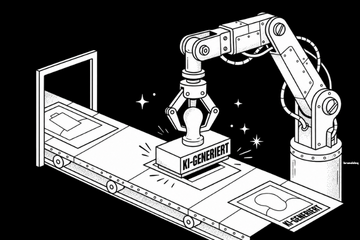
- “KI-generiert”.
Or through clearly placed official EU icons provided by the EU online that clearly identify the work as AI-generated or AI-modified.
The example from Mercedes-Benz, which we illustrated as an agency, demonstrates how such a label can be placed directly on the image:

Demonstrating Commitment Through Transparency
Anyone who ignores the new guidelines taking effect in August risks fines or criticism from competitors, as well as a lack of transparency. An open approach to AI demonstrates that a brand is working innovatively. For us as a creative agency, the regulations change little; we continue to use AI as a powerful amplifier for bold ideas, but we ensure that this is done in a legally compliant and future-proof manner.