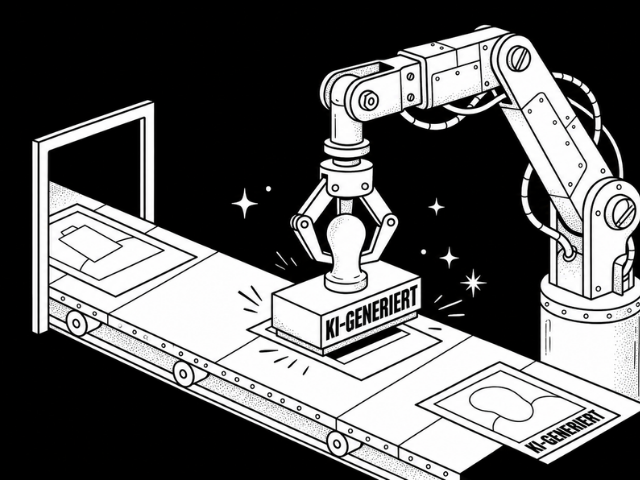
Content is dead. Long live content!
Why AI Responses Are Replacing Clicks—and How Your Brand Can Still Stay Visible with GEO- 5 min reading time
“Content is dead.” You hear that phrase quite often these days. The observation behind it isn’t entirely wrong: These days, when people have a question, they ask ChatGPT or read the answer right at the top of Google’s search results. People are clicking on websites less and less when searching for content. Does that mean we can do without blog posts and how-to guides? Probably not. AI has to get its answers from somewhere. This is exactly where GEO—short for Generative Engine Optimization—comes in. It refers to preparing content in such a way that AI systems like ChatGPT or Google can find it, understand it, and incorporate it into their responses.
Fewer clicks don't mean less interest
A study by the Pew Research Center shows just how much search behavior has changed. To determine this, researchers analyzed the Google searches of 900 adults in the U.S. over the course of a month. When an AI summary appears at the top of the results, people click on one of the links below only about half as often.
At first glance, this is disheartening for anyone who writes content. But upon closer inspection, it becomes clear: the demand for good answers hasn’t decreased. People haven’t stopped asking questions—quite the opposite. They’re just no longer asking the search engine; they’re asking the AI instead. You’ve probably experienced this yourself: instead of clicking through ten links, you ask a quick question and get an answer in seconds.
The AI compiles this answer from what’s available online. This has long included texts written by AI itself. The AI decides which ones to use based on clear patterns: it selects what’s most understandable and helpful.
This brings us to the crucial question: Just how understandable and helpful are your texts, really?
What AI Likes to Focus On
AI looks for clear answers that it can associate with a brand. A well-structured website—which has always been important for good SEO results—helps here as well. But GEO goes even further and requires more. The difference lies in the text itself. It can’t make much of general advertising slogans. Here’s a hypothetical example:
Before: “Our innovative solutions sustainably increase your efficiency.”
After: “The software automatically plans delivery routes and shows the team at 7 a.m. every morning which vehicles are still available.”
Any company could write the first sentence. The second one says exactly what the software does, and that’s the kind of thing that will show up later in an AI response. For good copy, this means: the more precise, the better. This principle of linguistic quality isn’t new in itself, but it’s gaining even more importance in the age of GEObility. But clarity isn’t just important for text.
How convincing is your brand in GEO?
One thing that shouldn’t be overlooked in the discussion about GEO: branding is becoming more important again. If a mention in an AI response is sometimes the first—and only—time people encounter a brand, then it matters all the more whether—and what kind of—trust the name inspires.
A brand that knows what it stands for and communicates that consistently across all channels is also easier for AI to categorize. Companies that come across one way one time and another way the next, on the other hand, present a blurry picture. A clear, trust-building brand identity is therefore no longer a soft factor. It plays a decisive role in whether a company appears in the response—and whether people will then believe it.
Five Things You Can Change Right Away
- Get to the point faster. The most important answer belongs in the first paragraph, not at the end.
- Be specific. An example from a real project is more effective than three fancy adjectives. It’s better to write about what a product does rather than how great it is.
- Share what only you know. The AI can’t find your experiences or your customers’ questions anywhere else.
- Maintain brand consistency. Focus on clear, recurring brand messages and concrete proofs of trust.
- Try it out for yourself. Enter your customers’ typical questions into ChatGPT or Perplexity and see if your brand comes up.
Content comes to life when it has something to say
So content isn’t dead. It’s just that those who sound like everyone else have a harder time. That’s where we at VON HELDEN UND GESTALTEN come in. We work for companies that have something to say, and we help brands gain more visibility. With an outsider’s perspective, we see what often gets lost within a company: the knowledge, the attitude, and the experiences that make a brand unique. This gives rise to authentic content, and we ensure it appears where people are searching today. That way, it’s also recognized by AI. If you want to know how your brand is currently performing in AI-generated responses, we’d be happy to take a look at it with you. Just reach out to us.